Returns Revolution
- Turning Cost Centres Into Profit Centres
Free returns may have de-risked online commerce, but they have also normalised a structural inefficiency: vast volumes of inventory moving to the wrong place, at the wrong time, and at significant cost. Retailers have spent a decade optimising how inventory moves out. Far fewer have optimised what happens when it comes back. Return rates of 20% or more are eroding profits by as much as 10%, while generating an estimated 1.2 billion tonnes of CO₂ annually and creating space for fraudsters to game the system.
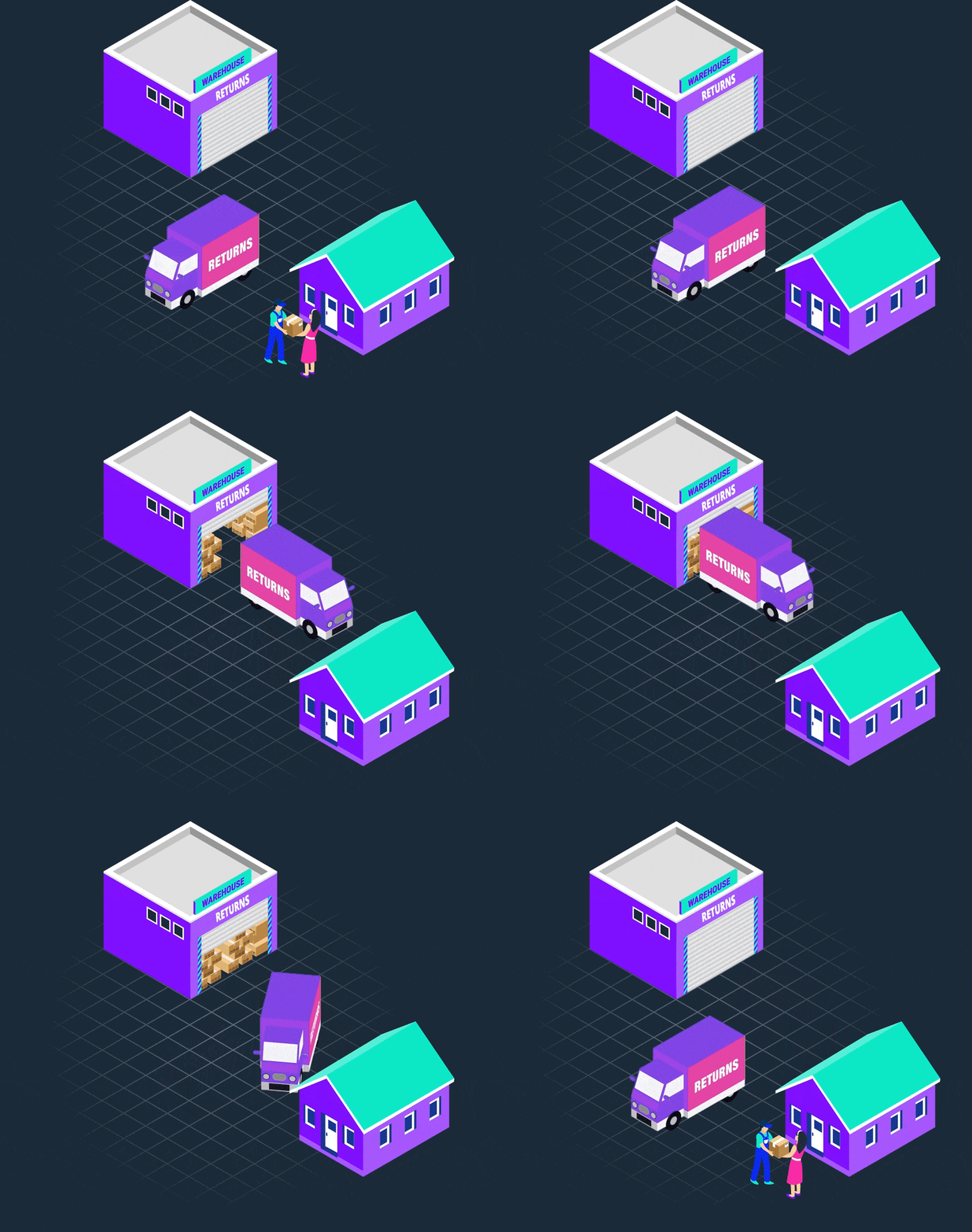
Customers have been trained to expect free returns – a model which is now collapsing under the weight of its own success. Retailers are quickly changing strategy: Zara is charging for home collections, H&M restricting return windows, Zalando testing fees for certain categories and ASOS blocking serial returners entirely. Indeed, Rebecca Hope, Head of Key Account Management at Royal Mail, notes that approximately 75% of e-commerce brands are already charging. But this comes with a significant trade-off. Research suggests around 75% of shoppers will abandon if return policies are unclear, and more than half will do so if returns are not free.

The first step to solving this problem, according to Leslie Rubio Olvera, Director of Product Development at DHL Supply Chain, is to reframe the lens through which returns are viewed.
Think about returns as inventory in the wrong place. It shifts the entire way we think about it, because if returns are inventory, then they deserve the same accuracy, clarity and speed as forward logistics - and a proper second chance.
Leslie Rubio Olvera
Director of Product Development,
DHL Supply Chain

HOW CAN THIS APPROACH BE APPLIED TO RETURNS?
Pre-sale, this reframing encourages retailers to consider which customers should have priority access to flexible inventory flows. Rather than blanket returns policies, retailers can segment their customer base – rewarding loyal or high-value shoppers with free or premium return options – while applying more targeted measures elsewhere.
However, rolling back what consumers perceive as a right is inherently difficult. Early adopters risk competitive disadvantage, while those who delay face continued margin erosion as reverse logistics costs escalate.
The challenge is magnified by the retail industry’s treating returns, according to Hope, as something of ‘an afterthought’. This applies to the wealth of data that could be collected and interrogated were returns treated as an inventory management issue.

Your returns data is one of the most honest forms of feedback that you get from your customers.
REBECCA HOPE
Head of Key Account Management
Royal Mail
The most cost-effective intervention is upstream: reducing the volume of inventory which is misplaced in the first place. Enhanced product imagery, AI-powered virtual try-ons and accurate sizing guides all can make a significant impact. With a very simple intervention, one client of Arvato reduced return rates for cosmetics – where customers often purchased multiple shades of lipstick, returning most – by improving online imagery to better reflect true colour. Customers bought fewer items, but kept more. If inventory is still misplaced, it can be redirected into stores, where it can be immediately be reabsorbed into active demand – and potentially trigger incremental value. According to Ole Kulinski, Arvato’s Director of Transport Management, one of their clients found that, when customers opted for BORIS (buy online, return in store), 30–35% made an additional in-store purchase. This not only reduces reverse logistics costs but also drives incremental revenue. In another example of how efficient routing can increase the value recovery of misplaced inventory, integration with out-of-home (OOH) delivery networks can make returns processing up to five times more efficient while aligning with consumer demand for convenience. In the UK, one OOH provider reports that 78% of parcel volumes through its locker network are now returns - far beyond its original intent. Advanced analytics also enable smarter decision-making across the lifecycle: from identifying high-return SKUs before purchase, to detecting fraudulent behaviour, to determining when it is more cost-effective to let customers retain low-value items rather than return them. Optimised routing can further accelerate resale, and the important work of refurbishment and recycling. Ultimately, there also needs to be a mindset shift, not just by consumers who may be unaware of the waste their return-happy behaviours generate but by all members of the supply chain.



Ultimately, there also needs to be a mindset shift, not just by consumers who may be unaware of the waste their return-happy behaviours generate but by all members of the supply chain.
Get in touch

Ellie Kennedy
Senior Business Development Executive,
Leaders in Logistics
Stay in the loop with Leaders in Logistics
Subscribe to our newsletter to receive news,
updates and special offers.
By submitting this form you agree to our Privacy Policy and Terms & Conditions