AI: FROM INCREMENTAL GAINS TO SYSTEMIC IMPACT
AI is no longer experimental. Across the logistics and postal sector, organisations have put in place AI solutions which have made meaningful differences to operations, products and, ultimately, the bottom line. Yet despite this progress, very few can be described as truly AI-powered. Most businesses are applying AI in pockets rather than coordinating it across workflows, systems, and decision-making processes. This gap between adoption and orchestration will be the industry’s defining competitive divide.

AI will significantly speed up the pace of reinvention – new products, new services, new efficiencies – as long as it can be orchestrated across the business.
Mark Briganti
Global Post and Parcel Lead,
Accenture

THE WORKFORCE EQUATION
Orchestration may be a technical challenge, but for AI to truly permeate throughout the business, workforce adoption is equally critical. The technology must be trusted, understood, and actively used by employees at every level.

You can never get the efficiency that a system promises you if you don't have the workforce on board.
Alexandra Weth
Head of Team Transformation & Employee Development,
Swiss post
Swiss Post is a case study in workforce-first AI transformation. Its Everyday AI 1 strategy began to accelerate innovation and boost productivity. There are now 40 AI-based business cases and 6,000 employees already using the internal AI tool 2.
The key is that this transformation has been accompanied by significant investment in training, transformation coaching, and communication. Employees at all levels are engaged in the process, with clear explanations of both the purpose of AI and its implications for their roles.
The question of driving adoption is important not only in long-established national posts, but also digital-first retail brands. THG Brands, which owns Myprotein, the world’s largest online sports nutrition brand, is facing similar challenges, as their COO, Tom Killeen, explains:
THE ROBOT REVOLUTION
Robotics provides an illustration in miniature of the broader challenge.
The technology is now relatively mature, as evidenced by the 40% of postal firms already prioritising robotics investment and expecting it to make a significant impact on the market in the next 12 to 24 months. Amazon's Vulcan uses touch-sensing which gives it an intelligence and dexterity to handle a wide array of warehouse jobs and Covariant's groundbreaking RFM-1 learns across real world use cases to ‘reason on the fly’ in a human-like way. GXO Logistics is experimenting with humanoid robots – ‘very exciting but there's a long way to go until they're doing what we want them to do’ according to Meagan Fitzsimmons, Chief Compliance and ESG Officer – and already deploys robot dogs to secure the perimeters of some of its vast warehouses. But what separates the experimenters from operators like Amazon – now deploying more than one million mobile robots – is not the technology, it’s the orchestration. Amazon has a cutting-edge generative AI model called DeepFleet which coordinates the movement of robots across the fulfilment network and enables them to operate as a unified and adaptive system.
BUILDING THE DATA BACKBONE
Underpinning all of this is data. Without integrated, high-quality, and accessible data, orchestration is not possible: systems cannot learn, decisions cannot be optimised, and AI remains confined to isolated use cases.
This is where many organisations encounter their most fundamental constraint: fragmented data architectures. Legacy systems, siloed datasets, and inconsistent standard limit the ability to connect information across the business.
To move beyond this, data must be cleaned, standardised and made accessible across the organisation. Cloud-based architectures provide the speed and scalability required, but the real challenge is integration: connecting operational events, customer interactions, asset movements into a unified and real-time data environment that AI system can act upon.
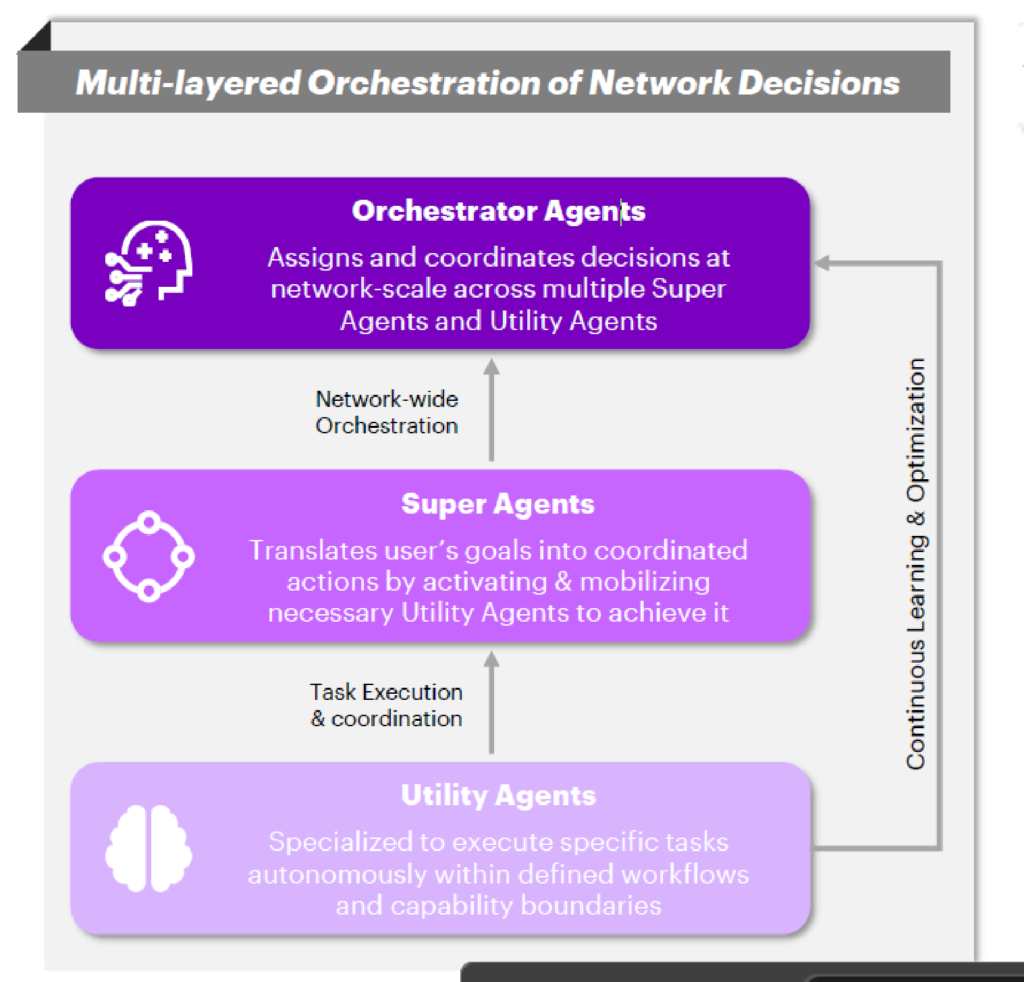
The structure of network-work, truly agentic AI; from Accenture’s post report.
Mark Briganti, Global Post and Parcel Lead at Accenture explains more:
The challenge for postal and logistics organisations is no longer the adoption of isolated AI use cases, but how to embed AI across the business. Those that succeed will move beyond isolated, incremental gains to systemic impact: becoming truly AI-powered businesses.



- https://www.microsoft.com/en/customers/story/25880-swiss-post-microsoft-365-copilot
- https://www.post.ch/en/about-us/news/2025/two-strong-voices-with-a-single-mission-how-responsibility-shapes-innovation-and-how-ai-is-becoming-fair
- https://www.aboutamazon.com/news/operations/amazon-million-robots-ai-foundation-model.
Get in touch

Ellie Kennedy
Senior Business Development Executive,
Leaders in Logistics
Stay in the loop with Leaders in Logistics
Subscribe to our newsletter to receive news,
updates and special offers.
By submitting this form you agree to our Privacy Policy and Terms & Conditions