THE COMPLEXITY-PROFITABILITY CHOICE
- Pick Your Strategic Fork
Logistics companies now face a structural choice: operate as low-cost, standardised providers, or scale complexity into a differentiated, higher-margin service model. The middle ground is no longer viable — too complex to be low-cost, but not differentiated enough to command premium pricing.


Cost is number one priority, with revenues in decline and almost two-thirds identifying margin erosion as a critical threat. According to Clare Bottle, Chief Executive of UK Warehousing Association, with margins of just 2-3%, logistics companies ‘might do just as well to put their money in a bank account’. Inflation in the industry, especially last mile costs, runs ‘about twice as high as general inflation’, according to Karl Pfaff, Chief Executive Officer of GLS Group. ‘It's quite intensive in terms of labour and investments into fleet and fuel and insurances, plus it’s a highly regulated space.’ Multiple pressures are converging at once: rising labour and energy costs, accelerating technology investment and increasing regulatory demands. At the same time, pricing power remains limited, with large customers exerting sustained downward pressure.
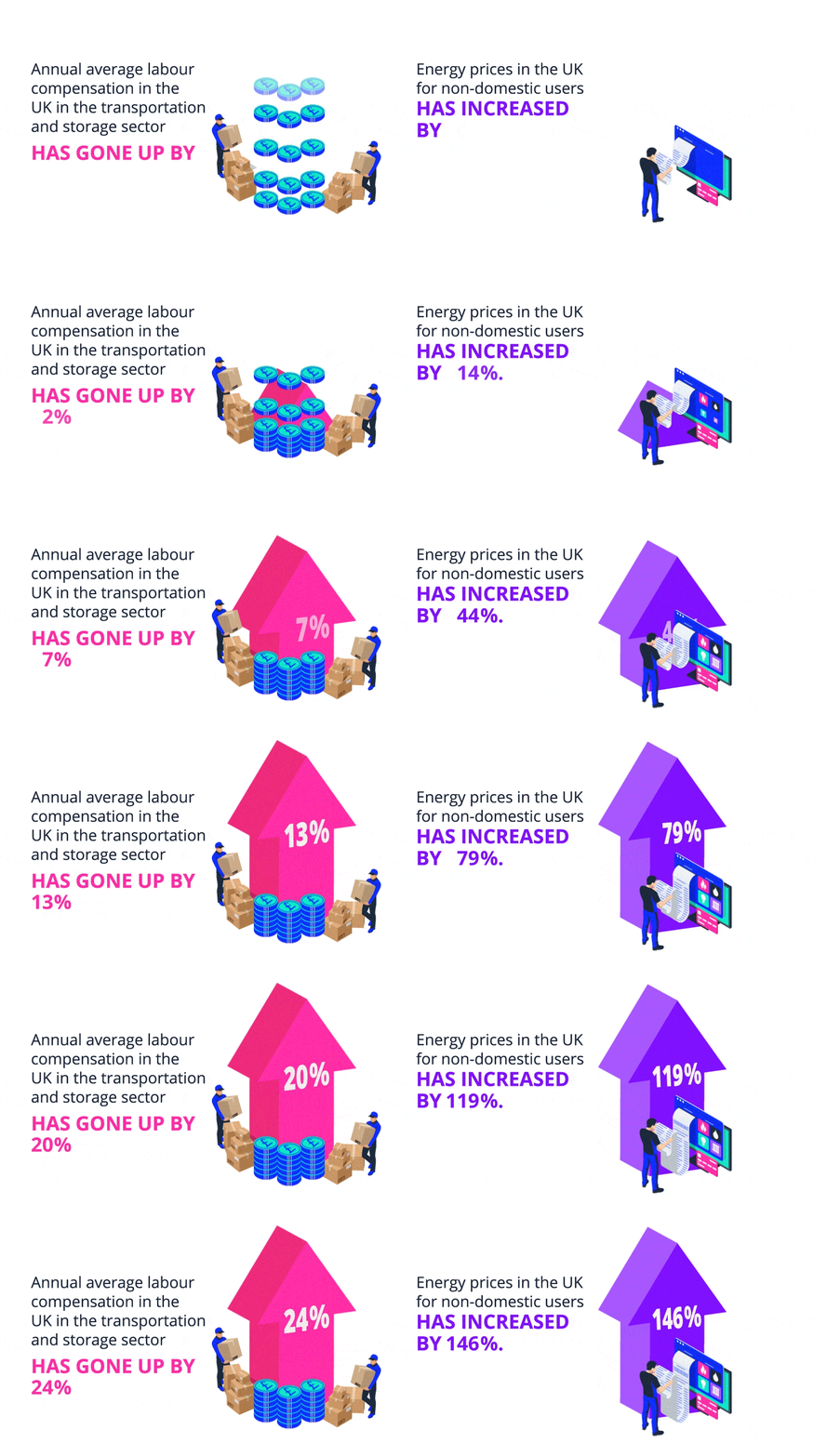
Yet pricing power remains limited. Large customers continue to exert downward pressure, even as their expectations expand. Today’s logistics providers are expected to support social commerce cycles, omnichannel fulfilment, custom delivery windows, flexible returns, and peak-period guarantees. The result is structural imbalance: complexity is increasing faster than revenue. ‘If you look at the combined industry profit pool in our industry globally in B2C, then we are probably at best break even or even loss-making,’ said Pfaff. Nowhere is this tension between complexity and profitability more visible than in the warehouse. Once a node in the supply chain, the warehouse has evolved into a hub of value-added activity, hosting activities ranging from basic assembly and packing to returns and refurbishment.



[The warehouse] is a place where there’s an opportunity to make more profit through these value-added services, doing things that were once retail activities, or manufacturing activities, or things to do with returns and the circular economy.
Clare Bottle
Chief executive,
UK Warehousing Association

This shift presents both opportunity and risk. On one hand, these services offer higher-margin potential. On the other, they introduce additional operational complexity, requiring greater coordination, labour flexibility, and technological sophistication. Without the right systems and visibility, complexity can quickly overwhelm profitability. The warehouse is therefore where the strategic choice becomes operational reality: where complexity is either monetised effectively or becomes a source of cost leakage. Data is essential to stay in the profitable sweet spot, according to Thomas Vermersch, Global Head FMCG Customers at FM Logistic. ‘When there’s not enough granularity, there isn’t enough visibility on the complexity of the operation.’ We see three key dimensions along which logistics providers are restructuring their operations.The first is the alignment of pricing with operational complexity. A shift from fixed-price contracts to flexible models, where price is aligned with service requirements, allows operators to capture upside associated with higher complexity. ‘The benefit is we can improve the margin if we perform,’ said Vermersch. The second dimension is refigured operating models designed to absorb variability more effectively. Multi-user models enable the pooling of demand across customers, smoothing peaks and improving utilisation. It’s a model that forces a shift toward rightsizing through smart deployment of resources across multiple clients.Tied to this is the ability to use flexibility as a competitive advantage. Solutions that enable rapid onboarding and scalability - particularly for small and mid-sized businesses - are helping companies respond to volatile demand patterns, including viral product trends and seasonal spikes. ‘Speed is key for these customers,’ said Meagan Fitzsimmons, Chief Compliance and ESG Officer at GXO Logistics, which offers a ‘plug and play’ solution, GXO Direct, which covers everything from payment processing to delivery, fulfilment to customization.The final level is cost transformation. Automation of course is central to this strategy, enabling companies to strip out costs through standardisation, lower labour costs and streamlined processes – as long as a carrier can support the high upfront investment during the transition period.
Nils Thiesen, Chief Commercial Officer Overland Transport at Rhenus, said consolidation is inevitable to fund the innovation and technology needed to meet customer demand and build sustainable businesses. Karl Pfaff agreed. ‘There will only be a few carriers, at least on an international scale, that will survive this transformation in a sustainable way,’ he said, adding this was the industry’s ‘Tesla moment’ – disrupt or be disrupted. The survivors, he said, will be those who become a digital platform player, operating across open networks and through partnerships with companies once considered rivals. ‘It's a solution to the cost if you have the financial means and the digital capabilities to do it,’ he said. The industry can no longer straddle both paths. Simplify to survive, or scale complexity with the capabilities to make it pay. Those that fail to choose risk being caught in the middle, where margins disappear and competitiveness erodes. Those that choose decisively will define the future of the industry.


Those that choose decisively will define the future of the industry. One thing is clear, a decision must be made: those who are caught in the middle will not survive.
Get in touch

Ellie Kennedy
Senior Business Development Executive,
Leaders in Logistics
Stay in the loop with Leaders in Logistics
Subscribe to our newsletter to receive news,
updates and special offers.
By submitting this form you agree to our Privacy Policy and Terms & Conditions