POSTAL TRANSFORMATION
Reinventing Critical Infrastructure
With mail volumes in structural decline, the financial sustainability of the universal service obligation (USO) is under increasing strain. Several countries, including Denmark, Lithuania, Germany and the UK have already begun dismantling or reforming long-standing postal frameworks, while others are actively reassessing their future.

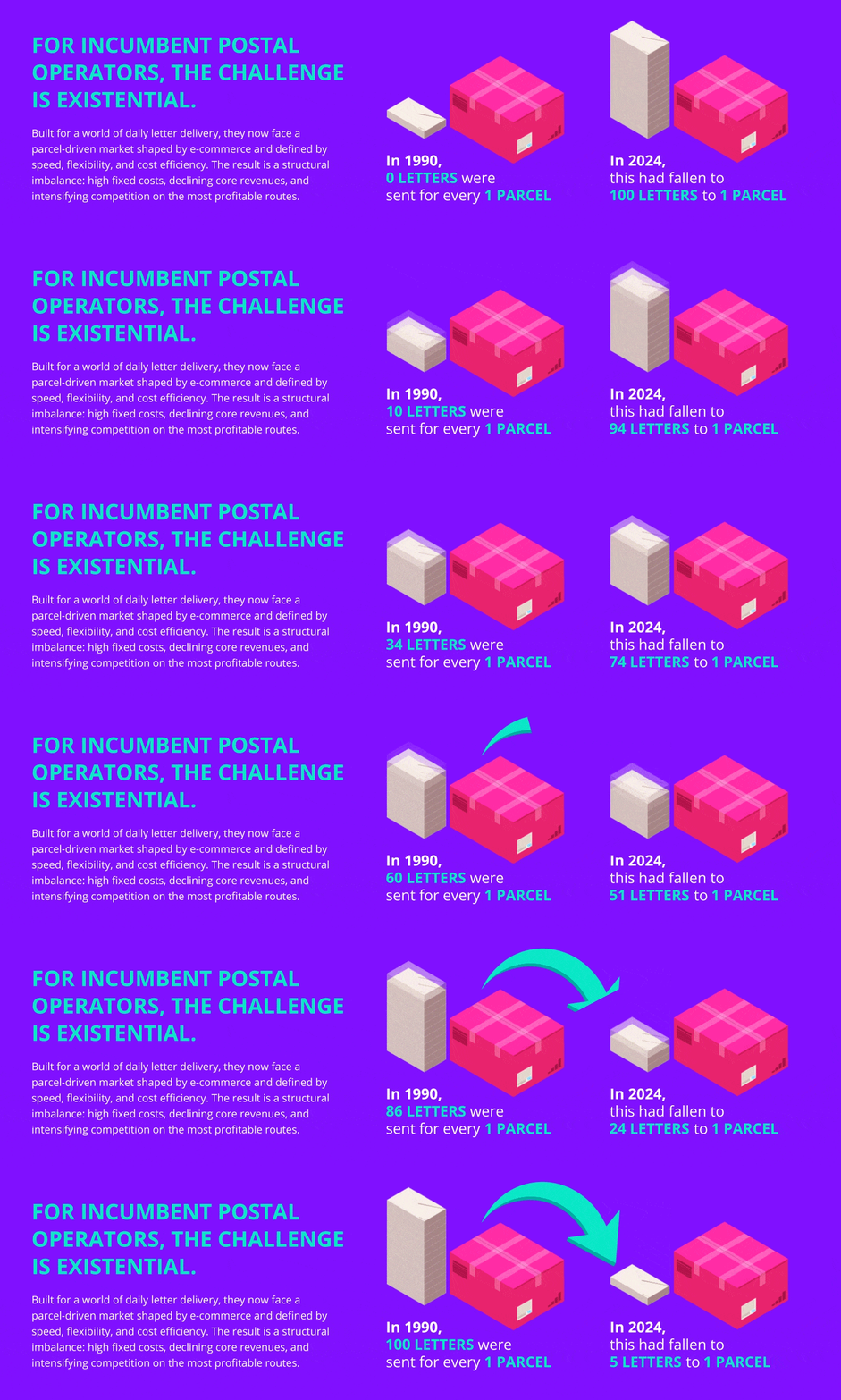
This dynamic has created a classic economic death spiral - falling volumes drive higher unit costs, which in turn lead to price increases and further volume decline. Little wonder, margin erosion is a critical threat for almost two-thirds of postal operators. According to Chris Peeters, Group Chief Executive of bnode, ‘mail is evaporating at a speed we have never seen before’. Annual declines of 10–15% are becoming typical, with digitalisation - from e-billing to digital communication - continuing to erode relevance. Mail is no longer the core product; increasingly, it is a residual flow within a parcel-led network.
Postal operators are not just facing declining demand - they are competing at a structural disadvantage. Universal service obligations impose extensive coverage requirements, fixed delivery frequencies, and significant labour and infrastructure costs. Meanwhile, private carriers operate with far greater flexibility, optimising their networks for parcels, cherry-picking profitable routes, and aligning operations with the needs of modern e-commerce, such as later injection times and dynamic pricing.
As parcels become the dominant traffic, legacy networks must be fundamentally reconfigured - or risk continued margin erosion.
Transformation begins with rethinking the last mile - not as a legacy obligation, but as a strategic asset. Postal operators possess a unique advantage: a deeply embedded delivery network and workforce with local knowledge that is difficult to replicate. Delivery personnel understand customer preferences, safe delivery locations, and neighbourhood dynamics- knowhow that remains largely undigitised but highly valuable.
‘They know who is behind the mailbox,’ said Peeters, who says this insight enhances the last-mile service beyond ‘just dropping a box in front of a front door’.
Mike Richmond, Managing Director, Consumer, Royal Mail, with its 500 years of postal legacy, said the relationship the delivery works have with the customers on the doorstep is a huge opportunity to build on that position of trust. ‘Royal Mail loses just two in 10,000 parcels, and that’s because of the posties,’ he said. ‘We don't make anywhere near enough of that incredible performance.’
Rather than discarding this legacy of knowhow and goodwill, leading operators are seeking to build on it, shifting from morning mail rounds to parcel-optimised delivery windows, expanding out of home networks and offering customers greater control over delivery location and timing. Rather than discarding what works – the personal touch of the postal worker with the choice and convenience of omni-channel operations and digital interfaces.
At the same time, operators are moving up the value chain. Investments in fulfilment, warehousing, and cross-border logistics are enabling them to capture a greater share of the e-commerce value pool and reduce dependence on domestic mail.
This marks a fundamental repositioning - from postal operator to integrated logistics platform.
Such transformation cannot be achieved without a fundamental overhaul of legacy systems and processes. Many postal organisations are burdened by decades-old technology architectures that limit agility and scalability. Modernisation efforts are therefore focused on building flexible, modular platforms that support rapid deployment of new capabilities, particularly in operations and e-commerce integration.
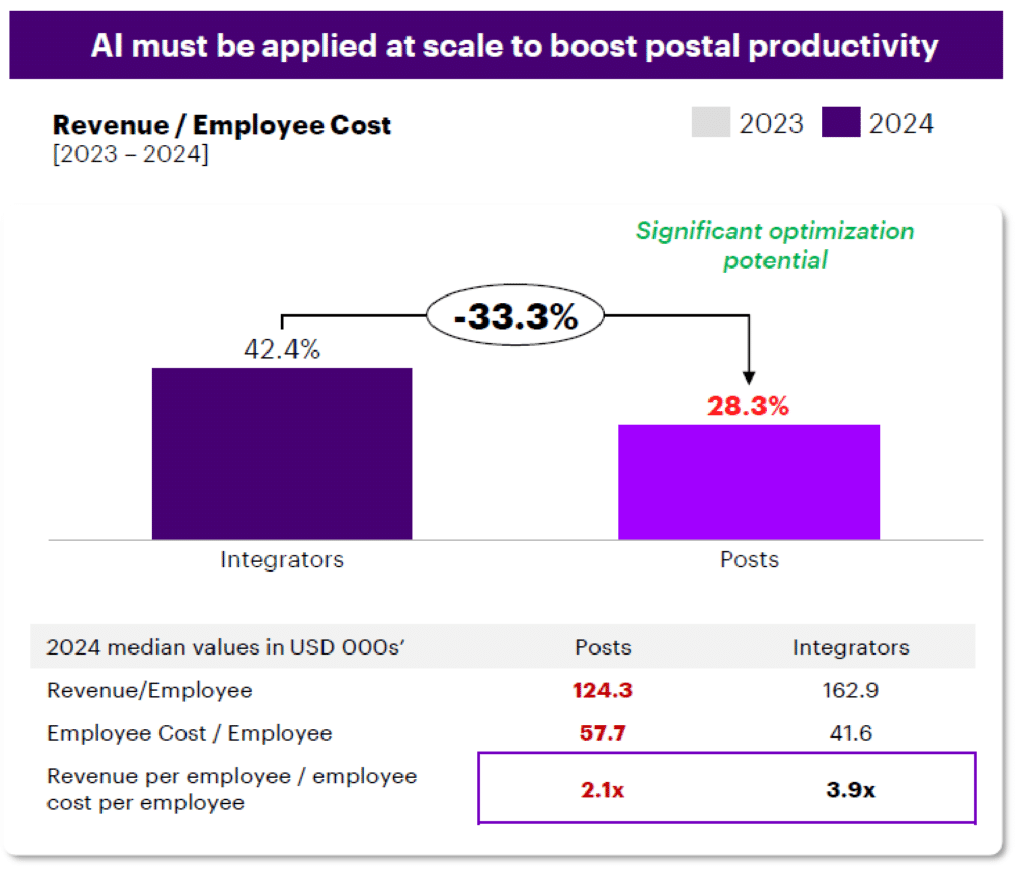
Posts are currently losing the efficiency race with competitors but have a significant optimisation opportunity through leveraging AI per Accenture’s Post Report.
‘We have a lot of historical legacy setups that we need to change,’ Andreas Thöni, Executive Vice President Group Strategy, Digital & Innovation at Österreichische Post and Chief Operating Officer, Aras Kargo. ‘That’s why we moved the technology to a setup that enables us now to deploy new components, particularly in the operational and the e-commerce sphere.’
Importantly, this transformation does not need to follow a ‘big bang’ approach. Incremental progress – delivering targeted, high-impact improvements – can build momentum and secure organisational buy-in.


Prioritse those projects that are going to deliver the value the quickest. Focus on the proof of concept, start small, make sure you can deliver the value that you think you're going to deliver and then you move it into a more industrialized scale.
Nigel Rouch
Senior Vice President of Technology Europe,
XPO
Artificial intelligence is emerging as a critical lever in this transformation, with applications across operations, customer service, and decision-making. There are tangible efficiency gains to be had, such as automated customer service through virtual agents - CTT, for example, has developed an AI-powered contact agent called Elena. Predictive analytics are seen as key to help postal operators better forecast demand, pulling together data from across the logistics ecosystem. ‘The better we are at predicting what's coming in the future, the better we are at executing, and the better the experience for our customers,’ said Nigel Rouch. Looking further ahead, automation will continue to reshape postal operations - from autonomous vehicles to robotic sorting and fulfilment. It is technically conceivable that, within the next two decades, highly automated ‘dark’ networks could operate with minimal human intervention - fully interconnected and optimised end-to-end. Yet, asked Rouch, while this might be technologically feasible, the question is how much is social contact valued? Postal networks have historically played a social role, providing human contact and community presence. As automation advances, operators will need to balance cost efficiency with the societal value of human interaction, particularly in rural or vulnerable communities.
A STRATEGIC CROSSROADS
The need to transform is clear but the path forward is far less certain. Every investment
in transformation competes with the immediate demands of maintaining legacy operations.
At the same time, well-capitalised competitors continue to invest aggressively in technology,
infrastructure, and customer acquisition, widening the gap between market leaders and laggards.
In response, many postal operators are diversifying through fulfilment and logistics services,
parcel locker networks, financial services and banking and EV charging and infrastructure.



Postal operators are moving from survival mode to redefining their role in the modern economy. Those that do not make this shift risk irreversible decline. The time to act is now – the window for transformation is narrowing.
Get in touch

Ellie Kennedy
Senior Business Development Executive,
Leaders in Logistics
Stay in the loop with Leaders in Logistics
Subscribe to our newsletter to receive news,
updates and special offers.
By submitting this form you agree to our Privacy Policy and Terms & Conditions