
INTERVIEW
Delivering more than parcels: the partnership turning lockers into a lifeline
What if the technology built to make delivery more convenient could also make life a little easier for people in need?
In Bulgaria, the Bulgarian Food Bank and Parcel Hive are putting that question into practice, adapting existing delivery technology and infrastructure for a very different kind of last mile – helping food support reach people with greater flexibility, privacy and dignity.
We spoke with Tsanka Milanova, Executive Director of the Bulgarian Food Bank and Board Member of the European Food Banks Federation (FEBA), and Nayden Nedyalkov, Managing Director of Parcel Hive, about how the idea began, what technology can change for people in need, and why they hope others across Europe will take it further.
Across Europe, we’re seeing growing demand for food banks, but reaching people in need can often prove difficult. Before this initiative, what were the practical barriers to getting food support into people’s hands?
Tsanka Milanova
The biggest challenge was not always having food available. It was making sure that food could reach people reliably, accessibly and, importantly, with dignity.
Traditional food support often depends on fixed distribution points and opening hours. For someone working, caring for children, living remotely or struggling with transport costs, these can become real barriers.
There is also a human dimension. Queues and crowded environments can make people feel exposed at an already difficult moment.
And behind all of this is a logistics challenge. Food banks can rescue food, but we still need to bridge the last mile between that food and the person who needs it.
So, for us, the question became: how can we make access to food support easier and more discreet, without adding another layer of difficulty to people’s lives?
Instead of asking people to adapt to a food bank’s logistics, we could start adapting logistics to the way people already live.
Parcel lockers were built for e-commerce. What made you realise that this network could be a way to support food distribution, and how did you end up working with Bulgarian Food Bank?
Nayden Nedyalkov
They were built for e-commerce; that is true. But what we actually built was something simpler: places where a person can collect something on their own terms — close to home, at a convenient time and without having to explain themselves to anyone.
The parcel was only what happened to be inside.
Our first conversation with the Bulgarian Food Bank was not really about technology. We listened before we talked about lockers.
What we heard was a last-mile problem, but also a last-few-metres problem: getting food to one particular person, at a moment they can actually manage, without costing them their self-respect.
That is something delivery infrastructure already solves every day.
So we built a dedicated locker network together. We wanted to stay close enough to learn how we could better serve people, especially those in need.
We say that we are inspired by technology and care. A project like this is where that sentence is tested.
Dignity is central to how this initiative was designed. How does collecting food support from a parcel locker change the experience compared to traditional distribution?
Tsanka Milanova
For me, dignity means giving people more choice and more control over their lives.
With a parcel locker, people can collect food independently, at a time that fits their lives and without the social pressure of standing in a queue or being identified as receiving support. They do it in essentially the same way millions of people collect something they have ordered online.
That may sound like a small difference, but it can completely change the experience.
Food support should not make people feel that they are different from everyone else.
We should not only ask whether food reaches someone. We should also ask what receiving that food feels like.
Nayden Nedyalkov
Tsanka describes dignity from the person’s side. From our side, it became an engineering decision as much as a human one.
The most important design choice we made was to do nothing special.
The locker looks and works like any other parcel locker. There is no “Help” menu, no marked compartment, no different colour — nothing that tells the people around you what you are collecting.
The same principle applies to data. Our system only receives what it needs to complete the delivery. The Bulgarian Food Bank retains the relationship with the person.
And there is another thing technology gives people: time.
A distribution point closes; a locker waits.
It does not care if somebody arrives at 22:40 because that was the first moment of the day that actually belonged to them.
Care is the part a person feels. Technology is the part they should never have to notice.
For other delivery companies considering embarking on a similar project, what are the key things you need to have in place? How much of this ran on infrastructure and processes you already had, and what had to be built or changed?
Nayden Nedyalkov
Almost everything behind the project already existed. We used the infrastructure, software and operational knowledge we work with every day.
The capability existed; we pointed it somewhere different.
Some things had to change. Food needs to be shelf-stable and packed to fit the compartments. Collection times need to reflect people’s lives, and personal data should be kept to a minimum.
But perhaps the most important difference is ownership. This cannot be something that works only when there is spare capacity. Someone has to own it operationally, with the same accountability as any commercial account.
If an ordinary parcel is late, somebody is annoyed.
If we are late here, someone does not eat.
And there is more than one way to participate. A locker manufacturer can build a dedicated network with a local food bank. An existing network operator can make capacity available. A carrier can contribute the transport.
We are prepared to share our technology, processes, integration specifications and what we have learned with those who want to try.
We would much rather see projects like this across Europe than keep what we have built and learned exclusive to Bulgaria.
If you could brief a room full of European delivery companies on what food banks actually need from logistics partners, what would you tell them?
Tsanka Milanova
I would tell them that food banks do not necessarily need logistics companies to build something from nothing for us.
Very often, we need help using what already exists – infrastructure, technology, transport, people and expertise – in a smarter way.
Reliability and flexibility matter, but so does a willingness to innovate together. This initiative came from combining the food bank’s understanding of people’s needs with the delivery company’s infrastructure and expertise.
So my message would be simple: look at the assets and capabilities you already have and ask where they could create social value.
You may be surprised by how much impact is possible without building an entirely new system.
For us, logistics is ultimately about making sure that food that would otherwise go to waste can reach the person who needs it most – at the right time, in the right place, and in a way that respects their dignity.
Logistics can deliver more than parcels. It can bring care closer to the people who need it most.
Join us at Leaders in Logistics Autumn on 6 October, 14:30–14:40 at the Innovation Stage to discover how delivery technology can become infrastructure for care – helping food banks reach more people in need, with greater flexibility and dignity.
Visit the Inspired by Technology and Care stand at the event to meet the people behind the initiative and hear directly from the Bulgarian Food Bank about how it works in practice.
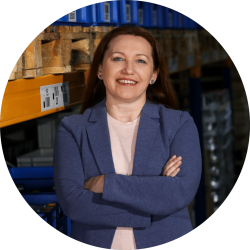
With over 20 years of experience in food banking, Tsanka Milanova has played a leading role in establishing and developing food banking in Bulgaria. Her work focuses on reducing food loss, recovering surplus food, and advancing food donation to ensure rescued food reaches people in need.

For the past 21 years, Nayden Nedyalkov has focused on innovation in last-mile infrastructure and today leads the development of Parcel Hive’s out-of-home ecosystem across European and Middle Eastern markets. His work focuses on building scalable systems, inspired by technology and care, that transform last-mile challenges into programmable delivery infrastructure.
About Inspired by Technology & Care
Inspired by Technology and Care is a social project by Parcel Hive and the Bulgarian Food Bank. Driven by our belief that technology should serve people, the project provides a dedicated locker network that makes food aid more accessible, flexible, and dignified for people in need.

Hungry for more? Check out
Leaders in Logistics Autumn
Join senior attendees at the retail logistics conference which brings together logistics decision-makers from retailers with the carriers, posts and 3PLs that enable their operations.
Have a story to share?
Book a call with us to learn more.
Ellie Kennedy Senior Business Development Executive Leaders in Logistics
Stay in the loop with Leaders in Logistics
Subscribe to our newsletter to receive news,
updates and special offers.
By submitting this form you agree to our Privacy Policy and Terms & Conditions